
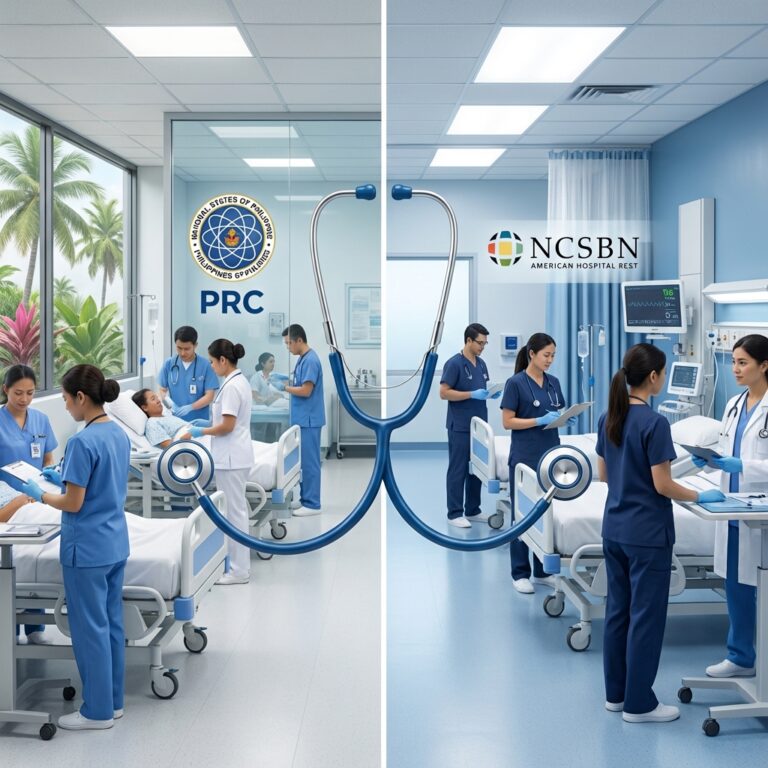

A side-by-side comparison to help you prepare strategically.
If you’re a Filipino nurse, you’ve likely encountered both exams: the NLE (Nursing Licensure Examination) for your Philippine license, and the NCLEX (National Council Licensure Examination) for US or Canadian licensure.
While both are nursing licensure exams, they’re fundamentally different in format, content, and approach. Understanding these differences is crucial for effective preparation.
Quick Comparison: NLE vs NCLEX
| Feature | NLE (Philippines) | NCLEX (USA/Canada) |
|---|---|---|
| Purpose | Philippine nursing license | US/Canada nursing license |
| Questions | 500 fixed | 70-145 (adaptive) |
| Days | 2 days | Single session |
| Format | Paper-based or CBT | Computer Adaptive (CAT) |
| Focus | Knowledge recall | Clinical judgment |
| Passing | 75% average | Pass/Fail (competency) |
Exam Format Differences
NLE Format
- 500 questions divided into 5 tests
- Tests over 2 days
- All students answer the same questions
- Score calculated as percentage
NCLEX Format
- 70-145 questions (varies per candidate)
- Computer adapts difficulty based on answers
- Correct → harder question; wrong → easier
- Pass/Fail result (no percentage)
Content Focus Differences
NLE Content
Emphasizes Philippine healthcare context:
- DOH programs and policies
- EPI immunization schedules
- Philippine Nursing Act (RA 9173)
- Community and public health
NCLEX Content
Emphasizes US healthcare and clinical judgment:
- Scope of practice (RN vs LPN vs UAP)
- Delegation and supervision
- HIPAA and patient privacy
- Prioritization frameworks
Question Type Differences
NLE Questions
- Traditional multiple choice
- Recall-based (“What is…”)
- Focus on memorization
NCLEX Questions
- Multiple choice + Select All That Apply (SATA)
- Drag-and-drop, hot spot, fill-in-blank
- NGN formats: Case studies, matrix, highlighting
- Application-based (“What would you do FIRST?”)
The Biggest Difference: Thinking Approach
NLE Thinking
Rewards knowledge recall: “What is the normal value for…?”
NCLEX Thinking
Rewards clinical judgment: “What would you do FIRST?”
This is the biggest adjustment for Filipino nurses. The NLE tests what you know; the NCLEX tests what you would DO with what you know.
Delegation: A Key Challenge
In the Philippines, LPN/LVN roles don’t exist the same way. For NCLEX, you MUST understand US delegation rules:
| Task Type | Can RN Delegate? | To Whom? |
|---|---|---|
| Assessment | ❌ Never | – |
| Nursing Diagnosis | ❌ Never | – |
| Evaluation | ❌ Never | – |
| Stable, routine care | ✅ Yes | LPN/UAP |
| Vital signs (stable) | ✅ Yes | UAP |
How NLE Preparation Helps NCLEX
What Transfers Well
- Core nursing knowledge
- Basic nursing skills
- Medical-surgical content
- Study discipline
What Needs Additional Study
- Clinical judgment model
- NGN question types
- US healthcare context
- Prioritization frameworks
Recommended Timeline: NLE to NCLEX
| Scenario | Gap | Reason |
|---|---|---|
| Directly after NLE | 3-4 months | Content fresh |
| Work in PH first | 6-12 months prep | Content refresh needed |
| Years post-NLE | 4-6 months intensive | Significant refresh |
Frequently Asked Questions
Is NCLEX harder than NLE?
They’re different. NLE requires more memorization (500 questions). NCLEX requires clinical reasoning. Many Filipino nurses find NCLEX more challenging because it tests application rather than recall.
Can I take NCLEX without passing NLE?
Some US states don’t require a Philippine license, but most nurses complete NLE first for credential evaluation and foundational knowledge.
How long should I wait between NLE and NCLEX?
Start NCLEX preparation within 3-6 months of passing NLE while knowledge is fresh.
Prepare for Both with RAGRS
At Ray A. Gapuz Review System, we offer comprehensive preparation for both NLE and NCLEX—designed specifically for Filipino nurses.
- NLE Review — Philippine board exam preparation
- NCLEX Review — NGN-focused US licensure preparation
- NLE-to-NCLEX Bridge — Targeted gap program
Contact:
- Website: raygapuzreviewsystem.com
- Location: United Nations Avenue, Manila